Monday, 22 July 2013
Maria Popova: "The law lags behind the culture; a good decade usually"
Wednesday, 10 July 2013
The Ways are Changing, Yet Law and Lawyer is merchant of the olden days
Monday, 8 July 2013
Being social online is more than just social media
"If I am a lawyer looking to use social media effectively, I am listening to key words and key phrases relevant to my area of law and the industry I represent. That’s in addition to the obvious ones – my name and the url of my blog.
I want company names, case names, regulations, and the names of other thought leaders. When such names are mentioned in influential sources – trade publications, blogs, Twitter, newspapers, and other mainstream media, I want it fed to me. I also want to have RSS feeds set up from relevant blogs and other influential sources. Twitter lists with the influencers and thought leaders are also critical.
With that sort of listening environment, I pick up a 360 degree assessment of the relevant discussion in my field. I can now strategically share what I am reading and engage in the conversation through my blog and other social networks.
Without such an environment, I am operating in a vacuum and totally in-equipped to take part in social media. Heck blogging and using Twitter without monitoring like that could be considered just making noise, rather than partaking in a conversation that builds trust, relationships, and a reputation."More here.
Irish courts must get with multimedia times says former DPP
"But the “system” to which Hamilton refers does not any longer reflect reality. The nexus between public opinion, the media and the administration of justice is no longer where it was 13 years ago when it was held that the former taoiseach could not be tried, putting him in effect beyond the law.
Experienced prosecutors are of course right to raise these issues. When and if charges are finally brought to full hearing, claims of prejudice and bias will be among the earliest hares to be coursed by defence lawyers. It will be pleaded that such has been the intensity of public anger, so vile have been the media in their coverage, and such has been the popular rush to judgment that it will be impossible to empanel jurors with open minds.
Hyper-connected world
But in the hyper-connected world of today it is unrealistic to expect that a panel of intelligent adults, possessed of reasonable deductive capacities, can be found who will not to some degree have “internalised” (Brian Cowen’s term) the shocking performance of the Irish financial system and of Anglo in particular. Nobody living in this State has been unaffected. So can prosecutions proceed only where jury members can be shown to have been living in some sort of cocoon? Taken to its logical conclusion it would suggest the criminal courts as a whole should be shut down."
Tuesday, 2 July 2013
We're living in an American legal world
We are living in an American world with 150 of the top 200 firms having their head offices in the USA. Next up comes the UK with 27 global firms, followed by Continental Europe with 15 firms (Germany, Spain & the Netherlands each on 3) and then Australia with 5 firms. However China (2), Canada (1) and South Korea (1) also make the list.
Saturday, 29 June 2013
Courts will be fully digital by 2016
"Courtrooms in England and Wales will be fully digital by 2016, the government says, ending what it described as "an outdated reliance on paper"."
He continued:
"It is part of a wide-ranging £160m plan to improve the speed and efficiency of the criminal justice system."
And this is interesting:
"Measures will include secure wi-fi in courts so lawyers and judges can access all necessary documents."
As are the comments from Justice Minister Damian Green:
"Justice Minister Damian Green said the plan would turn the courts system into a "modern public service"."
Thursday, 27 June 2013
Thereza Snyman on demographic transition at law firms
Tuesday, 25 June 2013
Traditional Media for Law Firms
Changes to law on whistle blowing
Monday, 24 June 2013
"Blogging makes me a better lawyer" - Reflections on a decade of legal blogging
Sunday, 23 June 2013
"A truly innovative law firm"
Timeline of social media articles, essays and blogs
- Jan 6 2012: Law Society of England and Wales says be careful when adding clients on social media.
"It will take a least an hour a day of their time and it will take six months to a year before you build any kind of momentum. If you're prepared to accept that, then it's a nice communication tool to have, but it's certainly not yet essential or any kind of magic bullet." Here.
Legal Week refers to "social media puff".
Law Society publishes 10 social media tips for lawyers
Saturday, 22 June 2013
Legal writing
http://lawyerist.com/origins-legal-writing-wars-part-two/
http://lawyerist.com/origins-of-the-legal-writing-wars-part-three/
http://lawyerist.com/origins-of-the-legal-writing-wars-constructing-sentences/
http://lawyerist.com/legal-writing-wars-seeking-precision/
Thursday, 20 June 2013
DPP publishes full and final social media prosecution guidelines
http://www.cps.gov.uk/news/latest_news/dpp_publishes_final_guidelines_for_prosecutions_involving_social_media_communications/
Telegraph write up here.
http://www.telegraph.co.uk/technology/social-media/10132657/Offensive-online-posts-to-escape-prosecution-if-writers-apologise-say-new-guidelines.html
Tuesday, 18 June 2013
Blogging stage fright
http://kevin.lexblog.com/2013/06/17/lawyers-lower-your-blogging-and-social-media-inhibitions/#.UcDbK5kckKQ.twitter
"All too many lawyers stiffen up when it comes to blogging and the use of social media. Rather than being themselves, they clam up and hide behind rules and policies designed to protect lawyers from themselves.
The result is many dry and unpassionate blogs that report news and legal updates without any insight, commentary, or personality. Heck, even Walter Cronkite signed off each night with a wink and departing catchphrase “And that’s the way it is,” followed by the date."
Kevin then considers the more immediate forms of social media. And don't be confused, a blog is very much a social medium. Any way, Kevin explains:
"Most lawyers engage little, if at all, on LinkedIn or Twitter. It’s the dry sharing of a piece of content — usually their own. No commenting back and forth or liking, in the case of LinkedIn. Heck, lawyers don’t even personalize invitations to connect on LinkedIn."
Sunday, 16 June 2013
Alex Aldridge Talks Legal Blogging
Hear the podcast in full here.
Also of interest should be the podcast by Kevin Poulter and Alex Aldridge again who chat to Leon Glenister about blogging in a broadcast by the title, 'Write a legal blog, mind your Ps and Qs and get a job?'
Hear the second podcast in full here.
Coffee with Tech Lawyer, Tim Summers
I recently caught up over coffee with Tim Summers (@TimSummersUK), the plain speaking technology lawyer and co-founder of the exciting Temple Bright law firm. This catch-up came 3 months after our Zero-140 encounter of March 4 2013 – and coincidentally, 3 months since his firm’s move into Tech City, London. And thanks to a lot of intensive work and acclimatisation, a lot has changed for the good for Tim and Temple Bright in the 3 months past.
And of important note, Tim has made it clear that a lot has changed and developed by his way of thinking. I began (my questions are in bold):
"So Tim, back in March you appeared keen on social media as a tool for the modern law practice. Asked if social media played an important role, you said: “Yes, as in every other kind of business. As with anything, you gain in proportion to how much effort you make."
How have things been on the social media front since our last chat?
“ Since opening our London office in Silicon Roundabout, I have become a convert to the use of social media and blogging for business purposes (although, as I now appreciate, the idea of having separate “business” and “personal” identities/aims is increasingly in question.).”
The Best of Bloomberg Law
http://m.youtube.com/user/bloomberglaw?&desktop_uri=%2Fuser%2Fbloomberglaw#/watch?v=h30_AQRqDcs&feature=plcp
This gives us the opportune moment to Segway into saying that a blog should be consider the online home of any law firm or lawyer.
Also opportune to throw up the reminder that we had already spoken about how general counsel are actively reading flaw blogs and recruiting and hiring on that basis.
http://m.youtube.com/watch?v=SOQfoTqTRsA&feature=plcp
Lee Pacchia said:
"Law firms are fragile economic entities and when they fail, they fail massively ."
Saturday, 15 June 2013
Legal Marketing Watch: Cleaver Fulton Rankin
In the face of a bold new world, law firms face one core challenge: to change and adapt.
Just what the doctor ordered - if you don't mind us analogously calling the celebrated Mr. Richard Susskind a doctor. So yes, law firms need to adapt to a new online and offline world. They need to change they way they operate internally and externally. By doing so they can begin to meet the new expectations and demands of a more sophisticated and equally price-sensitive client base.
One central tenet to any law firm change manifesto must be the need for differentiation from a saturated market. As per what Above the Law said here and as we explored more here and here and others here, here, here, here and here.
Traditional media for law firms
Being a late chronotype, mornings are never easy. Nonetheless, as I rose early on the morning of June 3 2013 I did the usual and switched onto Radio 4. And at 14 minutes past the ungodly hour of 6am the dulcet and lawyerly tones of Gary Miller came wafting across the airwaves; mixing it up of course with the fumes from my intermittent quaffing of coffee.
But back to Gary Miller - who is he? Mr Miller is an international litigator and insolvency specialist with Mishcon de Reya. A law firm we have come to grow found of at Elephant creative – see here and here.
Friday, 14 June 2013
Timeline - Legal Aid Reform

[The beginnings of this thread were originally published on Defero Law and can be seen here]
So, legal aid: where are we now? Verbal rumblings have been going on for months. The Ministry of Justice public consultation, 'Transforming Legal Aid' closed on June 4 (full consultation document here). The MoJ said it got 13,000 responses, but apparently this was the one to read:
If MoJ read just one response, this absolutely needs to be it “@richardmoorhead: Response to Legal Aid Consultation wp.me/pxDm8-nO”Elsewhere, Adam Wagner (@AdamWagner1) has been at his best, tweeting like an animal charged on Red Bull. Former pupil-barrister Harry Mount has been up stirring things up, writing a piece for the Spectator on June 8 on how 'Chris Grayling is right to reform legal aid'.
— Jeremy Hopkins (@Jezhop) June 3, 2013
That really got people's back up, as dozens launched themselves onto that out of control wagon. Though Harry Mount's piece has now been given a full front page (webpage) rebuttal on the Spectator, with an essay by barrister and media-face Jerry Hayes entitled, 'Harry Mount is wrong: Chris Grayling’s legal aid reforms will damage justice'.
Simon Myerson QC was also one of the first to hit out against Mount in the comment sections and has since penned two full pieces, 'Six reasons the cuts to legal aid will ruin our justice system' in the Independent, and then '9 Reasons whay Harry Mount's Hatchet Job on the Legal Profession Misses the Mark'.
There's also a piece by Mark Nayler in the New Statesman on how 'Harry Mount's attack on barristers is shot through with personal loathing'. Oh - and we can't of course forget the comedian John Finnemore's skit on the Radio 4's Now Show on Saturday 8 June.
The whole affair is pretty fluid and even since all the bluster above, the Justice Committee are now/have since been considering/considered the legal aid reforms; which includes, among others, Law Society president Lucy Scott-Moncrieff giving evidence.
Justice Select Committee meeting today at 9:30am on Legal Aid - parliamentlive.tv/Main/Player.as…
— Zoe Saunders (@ZASaunders) June 11, 2013
Evidence taken on @mojgovuk's proposals on transforming #legalaid at 9.30am @commonsjustice goo.gl/gtJ0t
— UK Parliament (@UKParliament) June 11, 2013
And the tweets are pouring out, including from Richard Moorhead (the man who's response to the 'Transforming Legal Aid' public consultation we were encouraged to read):
Legal Aid Justice Cttee @rogerjgsmith on BBC Parliament now.With extra stripes and a little dash of controversy
— Richard Moorhead (@RichardMoorhead) June 11, 2013
Thanks @thelawsociety for calling on Justice Select Committee to hear evidence on changes to #legalaid in civil cases too! #saveukjustice
— @savejusticeuk (@savejusticeuk) June 11, 2013
So far no question from committee is based upon credibility of the legal aid system.
— Northpod Law (@northpodlaw) June 11, 2013
Get off the fence Roger... RT @njbarmstrong Roger Smith at Justice Committee: "ineptitude of government never ceases to amaze me" #legalaid
— John Hyde (@JohnHyde1982) June 11, 2013
We can expect the flow of tweets to continue. In the mean time you can sign the petition against the reforms:
Why you should sign this:epetitions.direct.gov.uk/petitions/48628 Grayling’s turd burger of a plan on legal aid explained: youtu.be/fHhfpCP1kPU .
— Stephen Mangan (@StephenMangan) June 11, 2013
So that's it. Well my attempts at rounding up where we are. Thousands of words have been written in recent weeks, and many more are spilling out at this very moment. I'm watching the affair progress with interest and look forward to seeing how things settle down and whether Mr Grayling will listen to the calls against his reforms.
In the interim period, enjoy my cartoon.
Update:
On June 13 2013 the Bar Council published a response to the Harry Mount piece that appeared in the Spectator, published June 8. Read the response from the tweet below:
MMQC challenges Mount's angry & unfocused polemic: 'a fundamental ignorance of the British legal system' @spectator http://t.co/0vEVoZpSk5
— The Bar Council (@thebarcouncil) June 13, 2013
On April 18 2013 the Criminal Bar Association published, 'Price Competitive Tendering. A Solicitor's View from the High Street'.
See the June 13 blog post by Charon QC on the failing of Chris Grayling to know the difference between the Bar Council and the Criminal Bar Association here.
Also hear his April 30 2013 podcast interview with Michael Turner QC, Chairman of The Criminal Bar Association here.
There is also a Charon QC podcast interview with barrister and former MP, Jerry Hayes from May 25 2013, 'Jerry Hayes on the Lord Chancellor’s Legal Aid reforms – a sardonic commentary'.
Also is the April 23 2013 piece in the New Statesman by David Allen Green, 'How the Ministry of Justice’s proposal for the tendering of criminal legal aid is misconceived and illiberal'.
Senior judge, Lord Neuberger said that the proposed legal aid cuts would create two-tier justice system.
On June 19 David Allen Green commented on the Attorney-General's "most remarkable letter" to a group of barristers concerned about the legal aid reform.
The Supreme Court President and most senior judge in the UK weighed in on the Legal Aid reform debate. Read here.
"145 specially appointed Government barristers demand rethink on Legal Aid plans"
You should read the Legal Aid Changes Blog.
June 26, Lord McNally, Minister of State for Justice, Deputy Leader of the House of Lords wrote in the Huffington Post that 'Legal Aid Reform Is Necessary.'
Wednesday, 12 June 2013
Charles Christian on social media and the law
In one of his latest podcast in his Law Tour Report, Charon QC interviewed Charles Christian of Legal Technology. From 34 minutes of the podcast Charles Christian talks social media and the law surrounding contempt of court:
"[Social media has] put a broadcasting tool in the hands of many. Whereas before their only outlet would have been to write a "yours disgustedly" letters to the Daily Mail and the Telegraph - which an editor would have spotted, intercepted and binned - now they can get through all of that.
Croudsourced Law-making
Finland is getting ready to use crowdsourcing as a means of creating new law. Heavens above, a croudsourced law-making system - is there something there for us in Great Britain in central government and across the devolved legislatures?
"Earlier this year (2013), the Finnish government enabled something called a “citizens’ initiative”, through which registered voters can come up with new laws – if they can get 50,000 of their fellow citizens to back them up within six months, then the Eduskunta (the Finnish parliament) is forced to vote on the proposal."Though, it's rightly noted that we have something similar in GB. Albeit a lot more mechanical and citizen-unfriendly.
"Assuming they get their 50,000 signatures, each will have to be voted on by the Eduskunta. Compare that with, for example, the UK system – there, an e-petition that garners 100,000 backers wins the grand prize of being considered by a government back-office and maybe being discussed in Parliament."
Tuesday, 11 June 2013
Legal Bloggers Can Learn from Non-Legal Bloggers
There's an art to blogging. It's a form of itself. Subtle, but not difficult. But easy to get wrong. Blogging is not like law school. Blogging is not about dense, wordy, thick, verbose and impenetrable prose like the stuff in legal journals.
It's about being light, airy and bouncy. It's to be written the way you talk as Kevin O'Keefe of LexBlog said.
"Blog as you talk. It’s a conversation after all. If you cite cases and use footnotes when out to eat with clients, then have it when blogging. If you don’t, leave them at home when blogging."And if you're still unsure then we need to ask: how do you get better? My answer is: watch the best writers and observers in the blogging game. Kevin O'Keefe said the same thing:
"Develop your own blogging style from following successful bloggers. You may learn the most from non-law bloggers such as Dave Winer, the folks at Copy Blogger, Jeff Bullas, and Mashable writers."
'Tweeting in Convoy', Ctd
I've discussed the idea of 'tweeting in convoy' on this blog before here. And as is my habit, the idea has been growing and seeking out new avenues.
The latest musings have come from a great a post entitled: "Empowering your law firm employees to be social media ambassadors". There were two highlights.
One:
"Claim the law firm. Encourage your employees to proudly fly your firm name and link on their Facebook wall or Twitter bio."Two:
"Promote re-sharing. Once an employee has opted in to your firm’s social media networks, they’ll be exposed to regular updates. Empower them to share and retweet updates from your brand that they are excited about and moved by. Doing so you’ll connect with those on their networks."
Law Firms with Blogs grow faster, according to US research
Over to Kevin O'Keefe of LexBlog here and in the stats and video below:
- Blogging adoption. 156, or nearly four in five AmLaw 200 firms are now blogging.
- Growth in number of blogs. The number of blogs, 660, has grown exponentially, up 71% since our last study.
- Employment blogs being the most popular with 91 blogs, alone.
- Correlation between blogs and firm revenue.
Legal Aid Reform in Northern Ireland
http://www.legalaidreform.org/news/item/559-uk-david-fords-plan-to-save-legal-aid-millions
Justice Committee considers Legal Aid reforms
http://www.lawsociety.org.uk/News/Press-releases/Pressure-on-Grayling-intensifies-as-MPs-scrutinise-criminal-legal-aid-cuts/
Quick summary by BBC here, which also includes video clip.
http://www.bbc.co.uk/democracylive/house-of-commons-22857089
On the same day, Radio 4 broadcasted the last episode of 'Law in Action', presented by Joshua Rozenberg
https://twitter.com/joshuarozenberg/status/344500957247324160
Should UK Supreme Court record and publish all Judgements?
https://twitter.com/adamwagner1/status/344417803929014272
The other heavy hitting tweeter come barrister, Carl Gardner agreed:
https://twitter.com/carlgardner/status/344418971245756417
Then Charon QC, the fictional barrister but nonetheless irrepressible legal blogger and legal tweeter brought a measure of reality to the discussion:
https://twitter.com/charonqc/status/344419279472578560
Monday, 10 June 2013
Personal Branding for Lawyers
![]() |
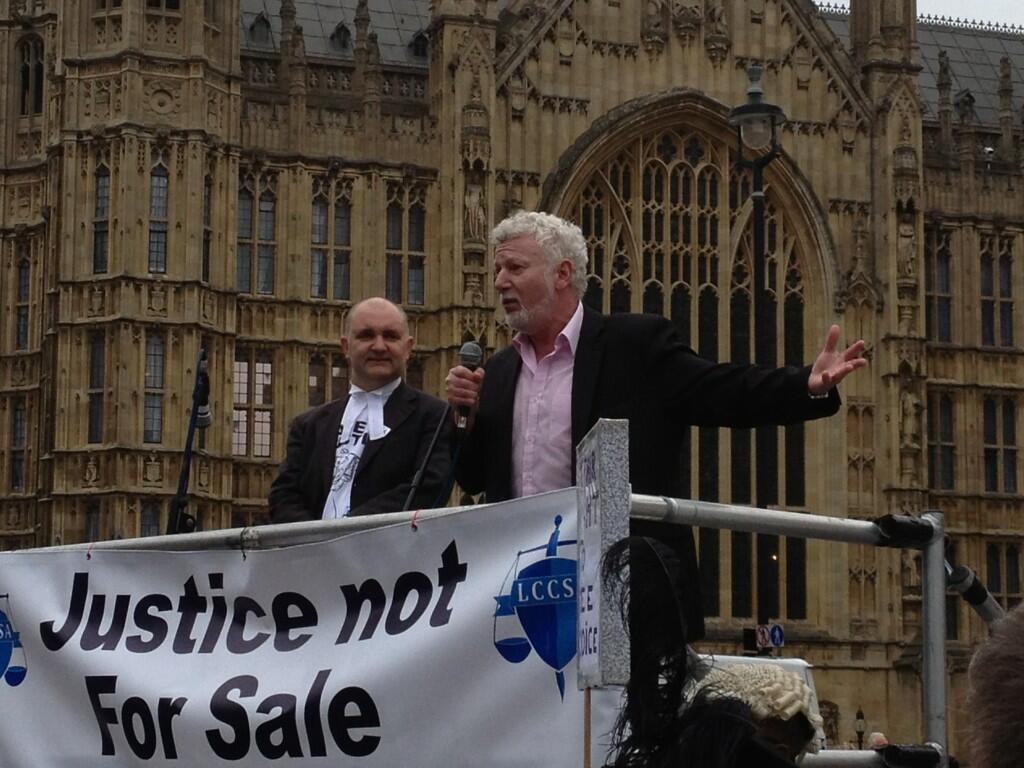
| Barrister Jerry Hayes doing his thing outside Westminster fighting against legal aid reform. |
Good starting point is with Belfast-based international libel lawyer Paul Tweed who calls www.paultweed.com home in the online world. Then there's former MP and TV face barrister Jerry Hayes who can be found at www.jerryhayes.co.uk.
There's obviously more to building a personal brand online and offline than a personal website. But as I've alluded to before: the blog/website give or take is the online home of the modern lawyer. Other social media channels can buttress and compliment this; but know this: the website and blog are the foundation.
Christopher Hitchens left England in part, because of the Libel Laws
We have a great tradition in this country. It goes back a long way; the classic statements of which are in John Milton's Areopagitica, and in John Stuart Mill's essay On Liberty where it is said (Christopher Hitchens paraphrases):
"However discredited an opinion may be, to ban it would still be a huge mistake; because otherwise there would be no way of finding out if you yourself had made a correct point. If you had no opponent; if you silenced them there would be no opponent. There would be no measure of your own articulacy or your own willingness to argue." (At 56 minutes 40 seconds of video above)Hitchens adds his take:
"Thus, it must always be the case that any opinion, no matter how unpopular must be at the front and centre of the argument."Christopher Hitchens then said that Rosa Luxemburg put it even better:
"Freedom of speech is meaningless unless it's for the person who thinks differently."Member of the audience then asked: "do you believe in the laws of libel and slander?"
Christopher Hitchens replied:
"No. I left England partly because of the laws of libel. It makes journalism almost impossible. Because again, it's a matter of her feelings (lady beside him). The person bringing a law suit in Britain (many of them tried it on me when I was here) has only to prove that their reputation has been damaged or that their feelings have been hurt. They don't have to prove what I say is not true."He then added a real shock and awe statement which if you think about it, does kind of ring true. Hitch said:
"There you have it again: it's a secular form of a blasphemy law." (At 57 minutes 25 seconds of the video above)Powerful stuff. YouTube video in full here.
Harry Mount versus Jerry Hayes and the Rest of the World
All of this and more in your pocket
This evolution of technology has revolutionized the way people live their lives and do business.
Lawyers and law firms have got to buy into this.
Understanding Legal Blogging
As Andrew Sullivan said in his essay 'Why I Blog', the blog is the new literary form of our age. And as Matt Mullenweg, the creator of the ubiquitous blogging platform WordPress said: blogging has given 'equality of access' and therefore utterly utterly democratised the ability to publish. Everyone now has a soapbox and a real voice that can reach a global audience. Matt said:
"Before the widespread rise of the Internet and easy publishing tools, influence was largely in the hands of those who could reach the widest audience, the people with printing presses or access to a wide audience on television or radio, all one-way mediums that concentrated power in the hands of the few."The same applies to lawyers. Lawyer can use the new form to give expression to their ability and expertise. By doing so they can build an audience, a following and a reputation as the go to authority on a given matter. Nowadays it's not enough for a lawyer or law firms just to carry on with their affairs in the offline world, they need to get online and carve out a space in the online world. And a blog is at the heart of this.
As Kevin O'Keefe of LexBlog said:
'A lawyer's home base on the web is their blog.'
Sunday, 9 June 2013
Law Students Aren't Using the Web with their Career in Mind
In the words of Richard Susskind we all know that "most lawyers are pathologically late adopters of IT." Though it will come. It'll just take a little longer. Susskind again:
"Despite promising, early successes, until the worth of an emerging technology is proven beyond reasonable doubt it will not generally be embraced by the legal world."Anyway, how are the young generation of law students, tomorrow's lawyers doing? As a part-time university lecturer Brian inkster has a genuine insight. Back in January 2011 Brian Inkster ran a straw poll: during a lecture to over 150 law students he asked them a number of questions regarding their web presence. Here's what he found:
"Of the 165 students it transpired that nearly all of them were on Facebook but only 4 on Twitter, 7 on LinkedIn, 1 on Quora and 2 had their own blog/website."
The Blog, Home of the Modern Lawyer
Kevin O'Keefe of LexBlog penned a great piece back in December 10 2012 which captures both the power of the blog and the central force of the blog for the modern lawyer and law firm.
Make sure to read his post which features references to Matt Mullenweg, creator of WordPress, and is entitled, 'A Lawyer's Home Base on the Web is their Blog'.
"A blog may not look sexy and, like all things worthwhile, takes a little time. But if you’re looking at vehicle to serve as a hub of your online networking, there’s nothing better than a blog."
Saturday, 8 June 2013
Legal Clock-Watching - Niall Ferguson suggests US Lawyers are worse than the British
It's only anecdotal, but still a strong observation from a reasonably reliable academic, historian and economist. Namely, Niall Ferguson.
Having started and ran various businesses in both the US and the UK, in an article here for the WSJ he does a bit of a compare and contrast. A number of pithy comparisons were made including making the observation that arranging health insurance in the US is a very real botheration. But what I found interesting was his observation on dealing with the lawyers. He said:
"As an academic, I'm just an amateur capitalist. Still, over the past 15 years I've started small ventures in both the U.S. and the U.K. In the process I've learned something surprising: It's much easier to do in the U.K. There seemed to be much more regulation in the U.S., not least the headache of sorting out health insurance for my few employees. And there were certainly more billable hours from lawyers."
Christopher Hitchens on Free Speech
More here:
http://www.youtube.com/watch?v=Uadgk2kveRU&feature=youtube_gdata_player
Friday, 7 June 2013
Student Sentenced for Lee Rigby Tweet
Student Deyka Ayan Hassan sentenced to community service for sending 'joke' tweet after Woolwich killing
that said that people wearing Help for Heroes T-shirts "deserve to be beheaded".
Read more about the case here and here.
A man was also arrested for making malicious communications over Facebook which you can read about here and here.
Chris Grayling's Consultation - 'Transforming Legal Aid'
This post is all about giving you the important facts and opinions you need to know about the Ministry of Justice consultation paper, “Transforming legal aid”; how the process panned out and how it was received etc.
The consultation process closed June 4 2013 and over 13,000 responses were received:
The Ministry of Justice have just confirmed that they have in excess of 13,000 responses to the Consultation on Transforming Legal Aid
— Chris Milligan (@milligan_cp) June 4, 2013
Thursday, 6 June 2013
Open Letter to Maria Miller Voices Concerns about Internet Freedom
Tuesday, 4 June 2013
The Role of Social Media in Turkey's Unrest
http://dish.andrewsullivan.com/2013/06/04/when-turkey-tweets/
More here:
http://dish.andrewsullivan.com/2013/06/06/a-menace-that-is-called-twitter-ctd/
UK Law Students Better Prepared for Work Than their US Cousins
![]() |
| The 12 panellists who featured in the Guardian panel discussion, chaired by Joshua Rozenberg. |
The Guardian recently hosted a roundtable discussion, chair by legal journalist Joshua Rozenberg on legal education in the US and UK. It was a bit of a compare and contrast exercise which threw up some interesting insights, including the one included in that title above, that UK law students are regarded as more work-ready than their American cousins. You can also read the Guardian article in full here, otherwise in full below [emphases are my own]:
"It is an exciting time to be an English lawyer – especially one prepared to look beyond England. The more economically globalised the world becomes, the more it needs globalised legal services, which means more career opportunities for law graduates willing to work in other countries and across jurisdictions, especially if they have an English legal background. With English common law the de facto law of business, and English the de facto language, the UK government has seized the chance to promote the UK as a commercial legal capital of the world, hoping this could be a key driver of economic growth.
Already 200 foreign law firms are operating in London and lawyers are bringing in about £3.5bn in foreign earnings.
The Rolls Building, a high-profile court complex opened in London two years ago, which is designed to attract complex business disputes from around the world, epitomises the government's vision of the future possibilities the legal profession offers.
How best to prepare fledgling lawyers for this potentially lucrative but challenging environment was the subject of a roundtable discussion last month attended by senior lawyers and legal academics and hosted by the Guardian. It was held in association with The University of Law.
Interview with Lee Pacchia
[This interview was originally published on Elephant Creative and can be seen here]
The Zero to 140 interview series has been on a truly global tour de discourse, picking the minds of some of the leading legal heads in the UK and America.
The latest up to the #ZeroTo140 interview table is Lee Pacchia (@leepacchia) of Bloomberg Law, a man who regularly sits down with the people that set the agendas and direct the future of the industry. We’re delighted to be able to include him in our series.
Brian John Spencer (BJS) : So Lee, what’s happening today?
Lee Pacchia (LP): Booking guests, writing scripts, taping programs and posting a video a day. Welcome to my world.
Social Media Law in Australia and America
Well in Australia, they're coming alive to the difficulties. In an article here, Adelaide Now discusses the challenge that social media posses to the trial by jury model and the criminal justice system as a whole. Here's what the paper said:
"The right to a fair trial is considered one of the fundamental rights of a defendant in a criminal case.
However, traditional measures such as suppression orders, designed to protect that right, are proving ineffective in the face of prejudicial material uploaded in real time on social media.
The culprit is not the traditional media, but jurors, witnesses and members of the public who become instant mass-media publishers with every post and tweet.
In addition, well-meaning jurors using the internet to conduct their own research about issues in trials threaten the court's ability to ensure that cases are decided only on the admissible evidence presented to the court."
High Court Judge makes new Social Media Law (re: Breach of CourtInjunctions)
Less than two weeks after the Hon. Mr Justice Tugendhat delivered judgment on the McAlpine v Bercow Twitter libel affair (see here and here), the UK's top media and libel judge has made new law and sent out another clear message to social media users.
Namely: the internet may have made everyone a publisher, however the internet did not made publishing responsibility free. Therefore, don't say anything on social media you wouldn't say on a print newspaper.
This time round the message from the legal mill is a little more social media-user friendly. OK, to understand things we need to go back to here on Defero Law. In that post entitled, "Is Social Media Uncontrollable?" I talked about two men who posted images of the two men who killed Jamie Bulger. This was in breach of a court order; therefore there was a legal effect to their actions (see Social Media and the Law: Know Where You Stand, my blog on the Huffington Post).
The two men were originally convicted and handed down prison terms. Now this has changed. See tweets bellow from Adam Wagner.
TWITTER, READ THIS JUDGMENT! 2 men who shared Jamie Bulger killer pics get 9 month sentences suspended for 15 months bailii.org/ew/cases/EWHC/…
— Adam Wagner (@AdamWagner1) June 4, 2013
… Court says in future serious social media injunction breaches, unlikely jail sentences will be suspended. TAKE NOTE bailii.org/ew/cases/EWHC/…
— Adam Wagner (@AdamWagner1) June 4, 2013
Full judgement available below in tweet from the Judicial Office:
High Court judgment in HM Attorney General v Harkins & Liddle (breach of Venables/Thompson injunction) now available bit.ly/13CrlZj
— Judicial Office (@JudiciaryUK) June 4, 2013
This is another important step on the road to hammering out the law that governs activity on the social web. Just this time the judge has made new law that makes it clear what will happen if you publish comments online that breach a court order. And as Adam Wagner rightly said: "TAKE NOTE!"